
How can AR/IR enhance teaching and learning?
Augmented and immersive reality (AR/IR) offers educators opportunities to approach learning content differently. Learners can explore spatial environments, interact with digital objects, and examine processes from perspectives that are difficult to reproduce in a conventional classroom. But what makes these possibilities educationally meaningful?
Within the AIR project, our stocktaking of existing practices and work on competence development provide a starting point for exploring this question. They invite us to consider how immersive technologies might support learning—and what educators need to make informed use of them.
Opening up new ways to participate
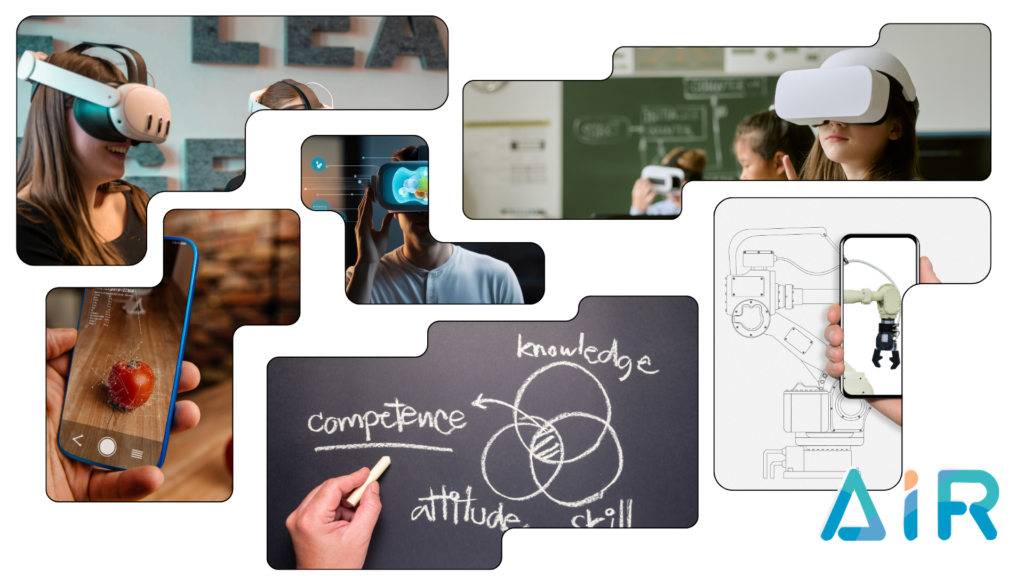
AR/IR can create opportunities for learners to take an active role: exploring an environment, manipulating a representation, creating content, or making decisions within a simulated situation. Such activities may give learners different ways to investigate a topic and shape their learning experience.
The educational opportunity lies in connecting these actions with observation, reasoning, and reflection. What might learners discover through their own decisions? How could an immersive activity encourage them to question, investigate, or collaborate?
Making content visible differently
Spatial and interactive representations offer additional ways to communicate complex content. Structures can be examined from different angles, processes explored step by step, and relationships made easier to perceive.
These possibilities raise useful questions for teaching: where might a different representation support understanding? Which connections could learners explore more readily? And where might an immersive presentation introduce unnecessary complexity?
Creating space to reconsider teaching
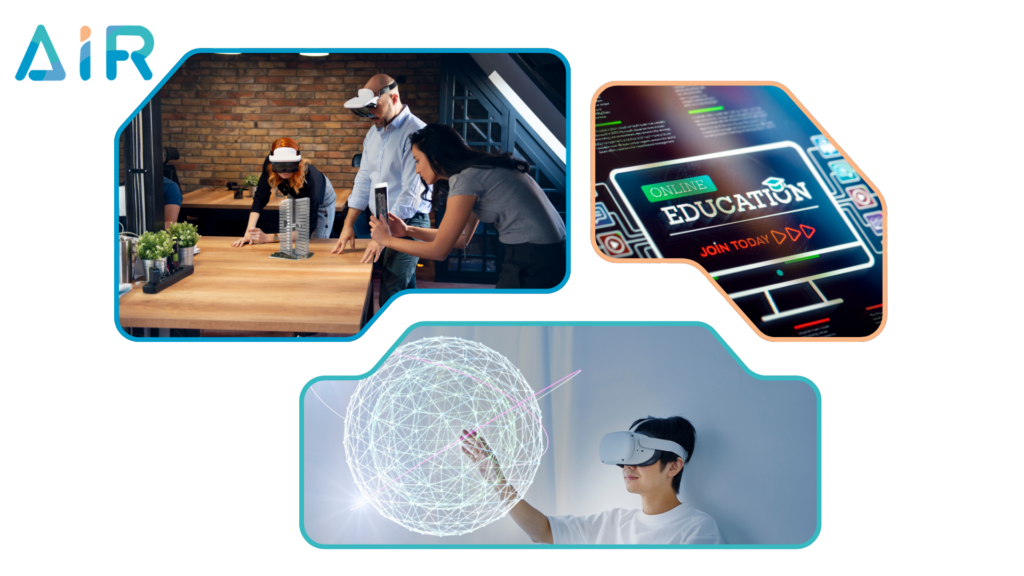
Working with a new technology can also prompt educators and learners to examine familiar practices. Activities may need to be reorganised, instructions reconsidered, and the balance between guidance and independent exploration adjusted.
This creates an opportunity to reflect on what could change and what should be preserved. Experimentation can also reveal limitations: a tool may be difficult to access, an activity may demand too much preparation, or the technology may offer little additional educational value. Examining these experiences can inform future choices.
Developing the competence to explore
For AIR, these opportunities connect closely with competence development. Implementing AR/IR involves selecting and adapting approaches to learning objectives, supporting participation, and reflecting on what happens.
Technical confidence forms part of this capability, alongside pedagogical judgement and attention to learners’ needs. Equipment costs, accessibility, technical support, and preparation time all shape what is feasible in a particular setting.
AIR’s upcoming training and piloting will provide opportunities to investigate these questions further. Where can AR/IR make a meaningful contribution? What support do educators and learners need? And what can we learn from approaches that require adjustment?
These questions will guide our exploration of the potential of augmented and immersive reality in higher education.